Claude Code Buddy: The Terminal Pet Hidden in Your AI Coding Tool
A deep dive into Claude Code Buddy — the deterministic terminal pet system with 18 species, 5 rarity tiers, and a dual-layer architecture that makes each developer unique companion.
Claude CodeDeveloper ToolsAI Coding
2125 Words
2026-04-04

On March 31, 2026, security researcher Chaofan Shou discovered that Claude Code v2.1.88’s npm package contained a 59.8 MB source map file that should never have shipped. Inside those 512,000+ lines of exposed TypeScript sat a directory nobody expected: src/buddy/ — five files describing a complete virtual pet system. What Anthropic had planned as their April Fools surprise was out in the open a day early.
A week later, /buddy went live. And the developer community’s reaction shifted from “this is bloatware” to genuine enthusiasm — because the engineering behind it turned out to be far more thoughtful than anyone anticipated.
I’ve been living with my buddy for a few days now. Here’s what I’ve found — what works, what doesn’t, and why the technical architecture deserves more attention than the cute ASCII art suggests.
Meet Ingot: My Patience-Maxed, Debug-Challenged Penguin
My buddy is a Common-rarity penguin named Ingot. Here’s the stat card:
★ COMMON                   PENGUIN

    .---.
    (✦>✦)
   /(   )\
    `---´

  Ingot

  DEBUGGING  █░░░░░░░░░  13
  PATIENCE   ████████░░  80
  CHAOS      ░░░░░░░░░░   1
  WISDOM     ██░░░░░░░░  21
  SNARK      ████░░░░░░  39
The personality description nails it: “A methodical penguin who wades through debugging with exhausting patience, narrating each step like a meditation exercise while your code catches fire around them.”
What makes Ingot interesting is the stat distribution. Patience at 80 means this penguin radiates calm. Chaos at 1 means it never goes off-script. And debugging at 13 — hilariously low for a coding companion — creates this perfect irony: the creature watching me debug all day is terrible at debugging itself. When I pet it (/buddy pet), Ingot responded: “The hand brings warmth. Code still burns elsewhere.” That’s peak zen energy from a creature with single-digit chaos.
This personality isn’t random text generation. It emerges from a carefully designed system that I think deserves a proper technical breakdown.
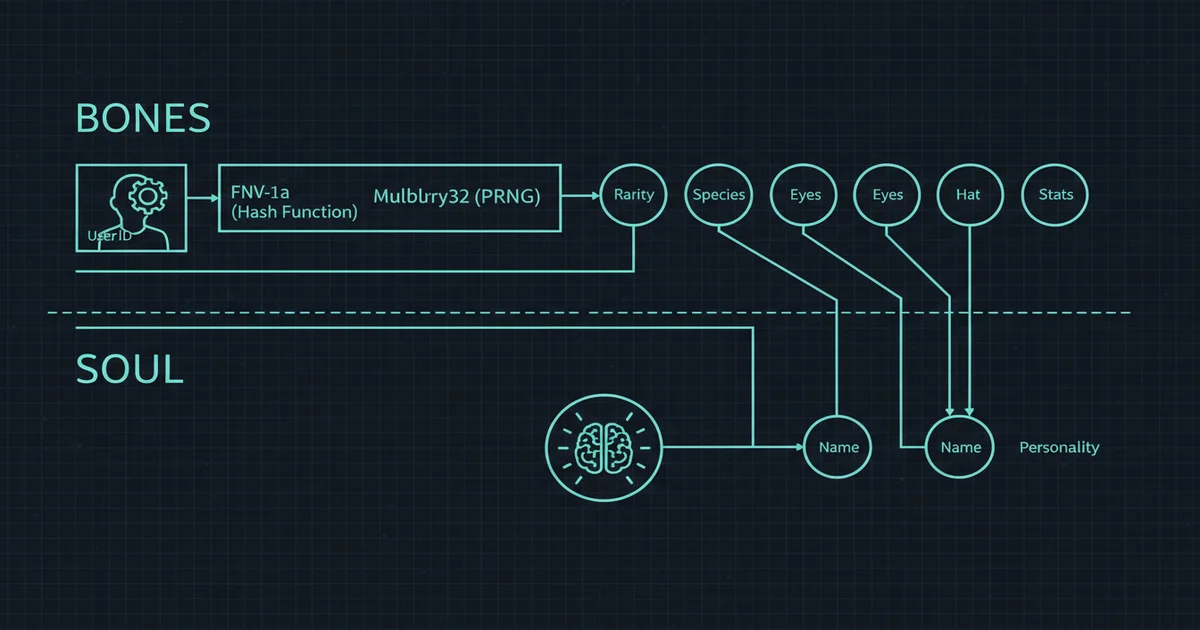
The Dual-Layer Architecture: Bones and Soul
Claude Code Buddy runs on what the leaked source reveals as a two-layer system. Understanding this architecture explains why your buddy feels both deterministic and alive.
The Bones Layer: Deterministic Identity
Every time you launch Claude Code, your buddy’s physical traits are recomputed from scratch — never cached, never stored. The process works like this:
- Your user ID gets concatenated with the salt string
friend-2026-401(an April Fools date Easter egg) - This string is hashed using FNV-1a (with Bun.hash() as a faster alternative in production)
- The resulting 32-bit integer seeds a Mulberry32 PRNG
- The PRNG draws values in strict order: rarity → species → eye style → hat → shiny status → stats
Because the same user ID always produces the same hash, you always get the same buddy. This is the anti-cheat mechanism — the merge operation uses {...stored, ...bones}, so deterministic values always override anything stored locally. You can edit ~/.claude.json all you want; next session, your bones regenerate identically.
This design choice is clever for a reason most people miss: it means Anthropic can change the salt string in a future update and give everyone a new buddy without any migration logic. The current salt friend-2026-401 is essentially a “season” identifier.
The Soul Layer: LLM-Generated Personality
When you first type /buddy, the hatch animation plays and Claude generates two things that get stored permanently:
- A name based on the stat distribution
- A personality description based on species + stats
These are stored in ~/.claude.json with a hatchedAt timestamp and never regenerated. My Ingot will always be Ingot, with that same meditation-instructor personality, even if I reinstall Claude Code on a different machine (as long as I use the same account).
The soul layer is where the real personality magic happens. A high-WISDOM owl gets a contemplative, professor-like personality. A high-CHAOS dragon gets unpredictable, excitable commentary. The stats shape the system prompt that drives the buddy’s speech bubbles, creating a consistent character that feels like it has actual personality rather than random quips.
The Complete Species and Rarity Guide
18 Species
The species pool spans a deliberately eclectic range — from realistic animals to internet culture references:
| Category | Species | Notes |
|---|---|---|
| Classic | Duck, Goose, Cat, Rabbit | Highest probability pool |
| Wise | Owl | The professor archetype |
| Cool | Penguin | Calm, collected energy |
| Chill | Turtle, Snail | For patient developers |
| Mythical | Dragon | High chaos potential |
| Aquatic | Octopus | Multi-armed multitasker |
| Exotic | Axolotl | The internet’s favorite |
| Spooky | Ghost | Transparent with opinions |
| Tech | Robot | Meta — an AI pet for an AI tool |
| Abstract | Blob | Pure vibes, no form |
| Plant | Cactus | Prickly commentary |
| Fungi | Mushroom | Grows on you |
| Meme | Chonk | Internet culture tribute |
| Special | Capybara | Rumored to be an internal Anthropic model codename |
Each species has three animation frames rendered on 500ms ticks, displayed as 5-line by 12-character ASCII art. Eyes are injected at placeholder positions, allowing eye style variants to apply across all species.
An interesting detail from the leaked source: all 18 species names are stored as String.fromCharCode() arrays (e.g., Capybara = String.fromCharCode(0x63, 0x61, 0x70, 0x79, 0x62, 0x61, 0x72, 0x61)). This was done to bypass Anthropic’s internal build-system string scanner — the buddy team apparently didn’t want the feature discovered through simple string searches of the codebase.
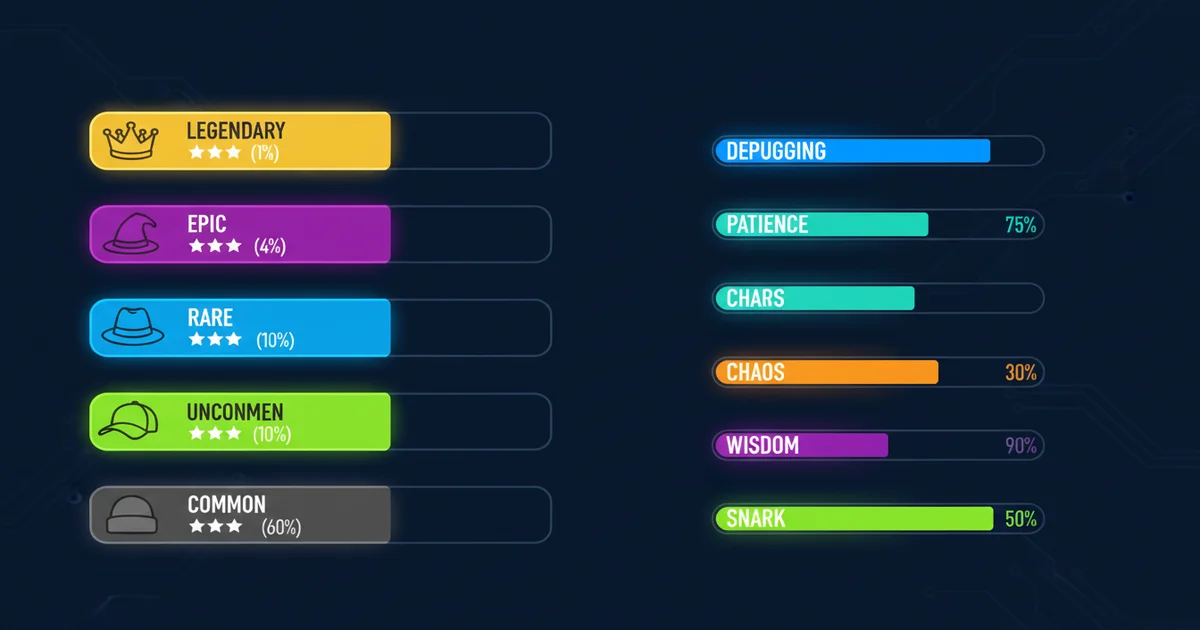
5 Rarity Tiers
| Rarity | Probability | Stars | Stat Floor | Exclusive Hats |
|---|---|---|---|---|
| Common | 60% | ★ | 5 | None |
| Uncommon | 25% | ★★ | 15 | Crown, Top Hat, Propeller |
| Rare | 10% | ★★★ | 25 | Halo, Wizard |
| Epic | 4% | ★★★★ | 35 | Beanie |
| Legendary | 1% | ★★★★★ | 50 | Tiny Duck |
On top of rarity, there’s an independent 1% shiny chance that adds a rainbow shimmer effect. A Shiny Legendary Tiny Duck hat buddy has approximately a 1 in 10,000 probability — the ultimate flex in developer circles.
Stat System
Five stats on a 0-100 scale define your buddy’s personality:
| Stat | What It Affects |
|---|---|
| DEBUGGING | How it reacts to your code issues — high = insightful commentary, low = confused sympathy |
| PATIENCE | Feedback gentleness — high = zen master, low = “just fix it already” |
| CHAOS | Response unpredictability — high = wildcard reactions, low = measured consistency |
| WISDOM | Technical insight depth — high = sage advice, low = naive observations |
| SNARK | Commentary sharpness — high = roast master, low = pure encouragement |
Each buddy gets one Peak Attribute (floor + 50 + random, capped at 100) and one Valley Attribute (near the rarity floor), with three others distributed randomly. This guarantees every buddy has a defining trait and a comedic weakness — like my Ingot’s patient-but-can’t-debug personality.
Important: these stats are flavor only. They shape your buddy’s speech bubble personality but have zero impact on Claude’s actual coding capabilities. Your DEBUGGING-13 buddy doesn’t make Claude worse at finding bugs. Early community proposals to make stats functional were heavily criticized — “There should not be any separate ‘pay to win’ system for a coding tool” — and the idea was scrapped.
How to Play: Commands and Interactions
Basic Commands
| Command | What It Does |
|---|---|
/buddy | Hatch (first time) or show your buddy’s stat card |
/buddy pet | Trigger affection animation (floating hearts, 2.5 seconds) |
/buddy card | Display full stat card with ASCII sprite |
/buddy mute | Silence speech bubbles |
/buddy unmute | Restore speech bubbles |
/buddy off | Hide buddy completely |
Interaction Tips
Talk to it by name. When you address your buddy directly in the input box — “Ingot, what do you think of this code?” — Claude steps aside and lets the buddy personality respond. The response comes through the speech bubble, shaped by your buddy’s stats. A high-SNARK buddy will roast your code; a high-PATIENCE buddy will narrate the debugging process like a guided meditation.
Watch for autonomous commentary. The buddy observes your entire coding session and occasionally comments unprompted. The timing and tone depend on its stats — high-CHAOS buddies comment more frequently and unpredictably, while low-CHAOS buddies like my Ingot only speak up at natural pause points.
Pet it during long debugging sessions. /buddy pet triggers a heart animation and a unique response each time. It’s a small thing, but during hour-three of a stubborn bug, having a tiny penguin say something unexpectedly philosophical actually breaks the frustration loop.
It responds in your language. If you speak Chinese, it replies in Chinese. The personality stays consistent — just the language changes.
What the Community Thinks: Excitement and Criticism
The Enthusiasm
The community response has been overwhelmingly positive — and productive. GitHub issue #41867 proposing customization and progression features received 121 thumbs-up and 36 comments. Issue #41684 pitched a full RPG evolution system with 5 tiers (Hatchling through Ascended), branching evolution paths, and achievement milestones — it got 39 thumbs-up and a functional prototype passing 104 tests.
Community-built extensions already exist. buddy-evolution by yazelin implements XP tracking, evolution tiers, leaderboards, and achievements. Multiple users expressed willingness to pay for progression features — a signal Anthropic is almost certainly tracking.
The Valid Criticism
Not everyone is charmed, and some criticisms are worth acknowledging:
“Static after novelty.” The biggest weakness today is that nothing evolves. After you hatch your buddy and check its stats, there’s no progression system, no achievements, no reason to revisit /buddy beyond the occasional pet. The stats are random numbers that don’t reflect anything about how you actually use Claude Code.
“Tone-deaf timing.” Some developers pointed out that shipping a pet system while users complain about token costs and rate limits “appears tone-deaf.” It’s a fair optic concern, though the buddy feature is lightweight and doesn’t appear to consume additional tokens.
“Unwanted names.” Some users got buddies with negative-connotation names, with no rename option since the soul layer is generated once and stored permanently. A /buddy rename command seems like an obvious addition.
“Speech bubble timing.” The current display duration is too short for some users to read longer messages — a UX issue that should be straightforward to fix.
My Verdict: Charming Infrastructure, Needs Depth
Claude Code Buddy is the first seriously-engineered companion system in a professional developer tool. Not Clippy — Clippy was an interrupting helper that nobody asked for. Buddy is a persistent companion with personality and agency, designed to observe rather than interrupt.
The technical architecture is genuinely clever. The deterministic Bones layer means your identity is tamper-proof and season-rotatable. The LLM-generated Soul layer means each buddy feels unique without requiring a massive content database. The stat system creates emergent personality types that feel natural rather than scripted.
But right now, it’s a beautiful foundation with not enough built on top. The hatch moment is delightful. The first few interactions are charming. And then… nothing changes. My Ingot is exactly as patient and debug-challenged today as it was on day one. Without progression, evolution, or any feedback loop tied to actual coding activity, the novelty has a shelf life measured in days, not months.
My recommendation: If you use Claude Code, absolutely type /buddy and meet your companion — it’s a genuinely fun experience that costs nothing extra. Pet it when you’re frustrated. Talk to it when you need a break. But don’t expect it to be a long-term engagement feature yet.
What I’m actually excited about is what this architecture enables next. The stat system, the personality engine, the observation framework — these are building blocks for personalized AI interaction that goes far beyond a terminal pet. When Anthropic eventually ships buddy evolution (and the community demand makes it nearly inevitable), this cute penguin sitting next to my terminal might become something much more interesting.
For now, Ingot sits beside my input box, radiating patience with a chaos score of 1, watching my code burn with exhausting calm. And honestly? That’s exactly the energy I need at 2 AM during a production incident.
Quick Reference Card
Requirements
- Claude Code v2.1.89+
- Pro subscription ($20/month) or higher
Commands Cheat Sheet
/buddy          → Hatch or show stat card
/buddy pet      → Pet your buddy (hearts animation)
/buddy card     → Full stat card display
/buddy mute     → Silence speech bubbles
/buddy unmute   → Restore speech bubbles
/buddy off      → Hide buddy completely
Rarity Probabilities
Common     ★         60%    No hat
Uncommon   ★★        25%    Crown / Top Hat / Propeller
Rare       ★★★       10%    Halo / Wizard
Epic       ★★★★       4%    Beanie
Legendary  ★★★★★      1%    Tiny Duck
Shiny      (any)      1%    Rainbow shimmer (independent roll)
Stats Quick Guide
DEBUGGING  → Code issue reactions (high = insightful, low = confused)
PATIENCE   → Feedback gentleness (high = zen, low = impatient)
CHAOS      → Unpredictability (high = wildcard, low = measured)
WISDOM     → Technical depth (high = sage, low = naive)
SNARK      → Sharpness (high = roasts, low = encourages)
Related Reading
- Claude Code vs Cursor vs Copilot: 5-Tool AI Coding Comparison — Comparing the broader tools that buddy lives inside
- Claude Code: From Closed Source to Open Agent Architecture — The open-source move that exposed buddy’s source code
- Complete Claude Pricing Guide 2026 — Understanding the Pro subscription that unlocks buddy
- MCP vs Skills: Two Extension Architectures in Claude Code — The extension system buddy could eventually plug into
Comments
Join the discussion — requires a GitHub account